Why Green Dashboards Are the Most Dangerous Thing in Your Company
The Real Risks of Schema Evolution.

Shen Pandi
March 10, 2026
It's Monday, 9:15 AM. You're still on your first coffee when the product manager appears at your desk. "Can you look at the user engagement dashboard? Something feels off." You pull it up.
The numbers are down 8% from last week, within the normal range, technically.
But you've watched this dashboard for two years, and you know: normal doesn't look like this. The line is too smooth. The daily spikes are missing. It's like someone replaced a heart monitor with a metronome.

By 10 AM, four more teams have questions. By noon, the ML engineers are blaming their model drift on "upstream data issues." By 3 PM, you've found the culprit: a single schema change, deployed Friday afternoon while everyone was logging off for the weekend.
The Mathematics of Broken Trust
Here's what actually happened when that "harmless" field appeared:
Twenty downstream dashboards didn't break in the way you'd expect. They didn't throw errors. They didn't stop loading.
Instead, each one fractured differently based on which consumer library it used, which version of that library, and how that library handled the unexpected union type.

Dashboard A, running on an older Python Avro client, simply dropped the event entirely when it encountered the new field. Not every event, just the ones where the field was present.
Its line charts now show a 15% drop in volume, but the drop is gradual, uneven, and invisible unless you overlay last week's data.
Dashboard B, built by a different team using a newer Java client, handled the field correctly but joined it with a lookup table that hadn't been updated. Suddenly, "unknown device" categories are spiking across every visualization.
Dashboards C through T all have their own unique corruption signatures. One shows flat lines where variation should exist. Another doubled certain metrics because a deserialization quirk duplicated records.
A third started producing nulls in places that never had nulls before, breaking every aggregation that assumed completeness.
Twenty dashboards. Twenty different ways of lying to your business. And not a single one of them raised an alarm, because from the infrastructure perspective, everything worked perfectly.
The Dashboard Paradox
This is the cruel irony of modern data systems: you built those dashboards to give you visibility, but they've become part of the blind spot.
You trust them because they're green. You relax because the numbers move within expected ranges. You assume that if something went wrong, you'd know.
But dashboards don't measure truth. They measure the data that reached them, transformed by whatever assumptions were baked into their queries months ago.
When the schema changed, the dashboards didn't adapt; they just kept running, faithfully reporting on a corrupted reality.

Think about what that means for a moment. Every chart, every KPI, every trend line your stakeholders reviewed that day was built on poisoned foundations. The marketing team made budget decisions based on those numbers.
The product team prioritized features based on those trends. The executives reviewed performance against targets that were never actually met.
By the time you notice, the damage isn't just in your systems. It's in decisions already made, reports already sent, strategies already locked in.
The Regression You Never Test For
You have regression tests for your code. You have integration tests for your APIs. But what tests do you have for your dashboards' assumptions?
Every dashboard embeds a mental model of the data it consumes.
The device_id field always exists. The event_type enum never adds new values. The timestamp is always in UTC.
These assumptions become invisible over time, just the way things are, until they aren't.
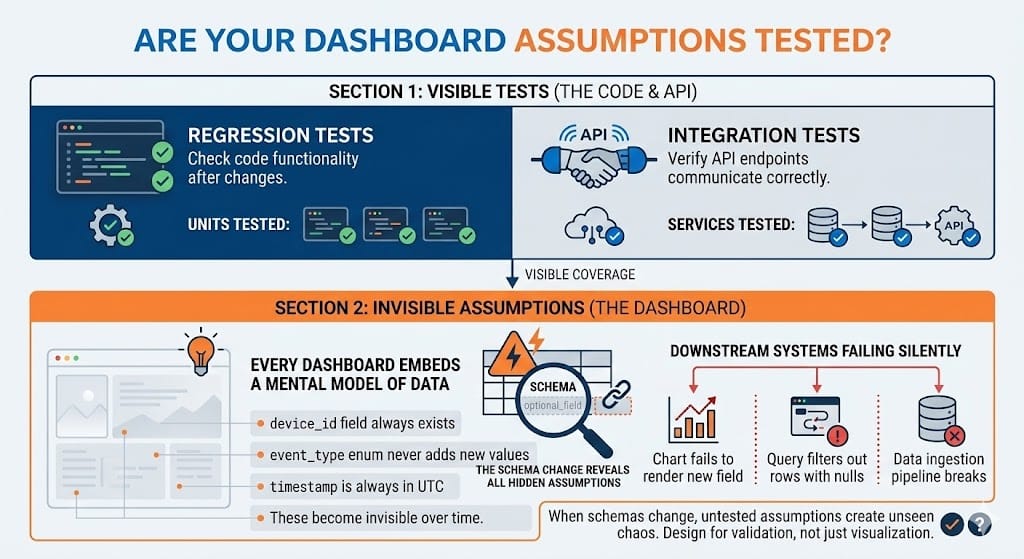
When that schema change added an optional field, it didn't just add data. It revealed every hidden assumption across twenty downstream systems, each one failing silently in its own unique way.
What You Actually Lost
When one schema change breaks twenty dashboards, you didn't just lose data. You lost time, the hours spent tracing corruption instead of building.
You lost trust, the fragile belief that when stakeholders look at a dashboard, they're seeing reality. You lost the ability to move fast because now every schema change requires paranoia and manual coordination.

The worst part? You'll never know the full cost. Some decisions made on bad data will never be traced back to that Thursday afternoon. Some trust, once eroded, never fully returns.
This is the real price of silent schema evolution. It's not measured in downtime or error rates. It's measured in the quiet erosion of confidence that spreads through an organization like fog, invisible until you're lost in it.
Warm regards,
Shen and Team