Why Does Your Data Warehouse Get More Expensive Every Month?
and why it won’t fix itself

Shen Pandi
April 21, 2026
If your warehouse bill keeps increasing every month, it is easy to assume the cause is simple: more data, more cost.
But that explanation rarely holds in production systems. Storage costs have become relatively predictable. What actually drives cost escalation is compute, and more specifically, how your queries interact with growing datasets.
As your business scales, dashboards become more complex, joins span multiple large tables, and ad hoc queries multiply across teams. What used to be lightweight analytical workloads start turning into full table scans, repeated aggregations, and inefficient joins.
The system is not just storing more data. It is working significantly harder to answer the same questions.
Where Do the Cost Actually Come From?
Most cost overruns originate from patterns that are invisible at small scale.
The same dataset gets transformed multiple times across different pipelines. Teams create their own intermediate tables instead of reusing existing ones. Queries that were designed for smaller datasets continue to run unchanged, even as data volume increases by orders of magnitude.
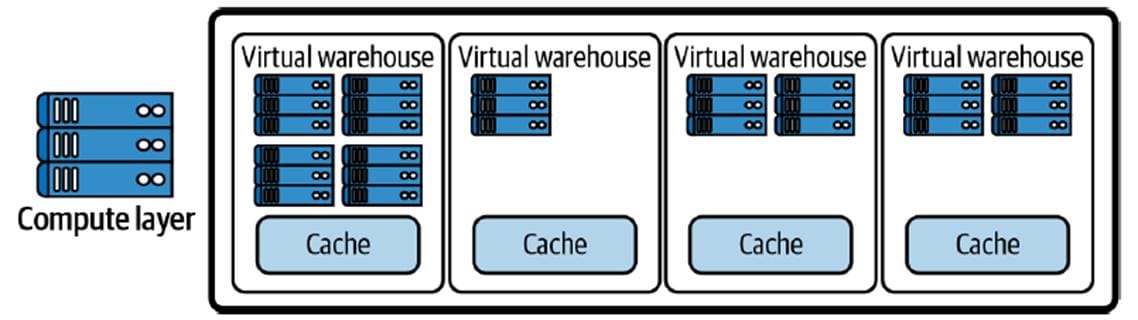
Concurrency adds another layer of complexity. Multiple teams querying the same warehouse at the same time lead to resource contention, forcing the system to allocate more compute to maintain performance.
Over time, you end up paying not just for data processing, but for redundant computation, duplicated storage, and poorly optimized query logic.
Why Doesn’t Optimization Efforts Last?
Most teams respond by optimizing queries, partitioning tables, or introducing materialized views. These steps help, but only temporarily.
The real issue is that the system keeps evolving without a consistent layer of governance. New pipelines are added, schemas shift, and business logic gets duplicated across teams, which gradually increases compute load in ways that are hard to track.
Without visibility into how data is actually being consumed, optimization becomes reactive. You fix one expensive query, only to see another one emerge somewhere else.
This is where DataManagement.AI changes the equation by bringing in predictive demand forecasting at the data layer.
It shifts from reactive to proactive cost management by embedding predictive demand forecasting directly into the data layer.
Then, analyzes historical query usage and workload patterns to understand how compute demand evolves over time.
Next, it identifies seasonal spikes and access trends across datasets and teams.
It also correlates data usage with business drivers like campaigns, reporting cycles, and regional demand.
Lastly, it forecasts future compute demand so teams can anticipate workload surges before they happen

This allows you to proactively optimize pipelines, allocate resources efficiently, and prevent unnecessary compute expansion before it shows up in your warehouse bill.
The Real Constraint: Uncontrolled Data Growth
The deeper issue is not query performance alone. It is uncontrolled data growth without lifecycle management.
Data is rarely deleted. Historical datasets are retained indefinitely, intermediate tables accumulate, and experimental pipelines become permanent.
As a result, every query operates on a larger and more complex data surface than necessary. Even well-optimized queries become expensive when the underlying data footprint continues to expand.
This is not a scaling problem in the traditional sense, and to be particular it is a governance problem.
What Should You Do Differently?
If you want to control warehouse costs, you need to shift your focus from isolated optimizations to systemic efficiency.
That means understanding how data flows across pipelines, identifying redundant transformations, and enforcing consistency in how datasets are defined and reused.
It also means introducing continuous observability into your data layer, so inefficiencies are detected early rather than after they appear in your billing dashboard.
Because your warehouse is not getting expensive by accident. It is getting expensive because the system is scaling without control.
Warms regards,
Shen Pandi & DataManagement.AI team