Want Both Performance and AI automation? 'Master' Data Management
Before AI, Do This!

Shen Pandi
January 28, 2026

Master data is now critical for AI/automation success.
Bad data causes direct financial loss.
Shift from managing data to improving processes.
New tech links data errors to business costs.
Fix data, then automate fixes.
Make data everyone’s responsibility.
From Idea to Automation: Build Intelligent Agents with AgentsX
Build the future of automation with AgentsX. Design and deploy sophisticated AI agents to create intelligent workflows that streamline operations and bring ambitious ideas to life across multiple industries.
Your organization stands at a critical inflection point. For years, the master data governing your core entities, suppliers, materials, products, and customers has been relegated to the background, treated as a static system of record managed reactively by IT. This approach is now obsolete.
You are navigating an era fundamentally defined by intelligent automation, artificial intelligence, and seamless process optimization.
In this new landscape, the integrity of your master data is not merely supportive; it is the decisive factor between success and failure. It forms the essential, non-negotiable foundation for every digital initiative you undertake.
This necessitates a complete paradigm shift. The time has come to reimagine master data management to evolve it from a technical, back-office function into a proactive, measurable performance engine that directly drives operational excellence and tangible financial value.
The High Cost of Invisibility: Why Your Current Data Problems Are Hard to Solve
The negative impact of poor master data is not a theoretical risk; it is a daily, quantifiable drain on your organization's efficiency and profitability. You experience the symptoms constantly:
Financial Leakage: Missed early-payment cash discounts from suppliers due to incorrect or incomplete payment terms in your vendor master. Overpayments for goods occur because of duplicate material entries or inconsistent pricing data.
Operational Friction: High manual effort in procurement, finance, and supply chain teams, where employees spend hours reconciling spreadsheets and correcting errors instead of performing value-added work. Delivery delays and customer dissatisfaction are caused by incorrect shipping addresses or product specifications.
Capital Inefficiency: Working capital is unnecessarily tied up in excess and obsolete inventory, often a direct result of duplicate or inconsistent material codes preventing accurate demand aggregation.
Strategic Stagnation: Severely limited scalability of automation programs. Rule-based robotic process automation (RPA) and more complex AI-driven workflows fail when they encounter "dirty data," leading to low automation rates and a high percentage of processes requiring human exception handling.
The central problem you face is not necessarily a lack of awareness that data is an issue, but a profound lack of visibility into the cause-and-effect relationship.
Your teams see the operational symptom, a delayed order, a missed discount, but they cannot trace it back to the specific faulty data attribute that initiated the failure.
Master data issues are known in a general sense, but they are rarely quantified or directly linked to their business impact in financial terms.
This gap between symptom and root cause makes it impossible to prioritize remediation efforts based on return on investment (ROI), leading to scattered, ineffective fixes.

This challenge is exponentially magnified as you invest in AI. AI and machine learning (ML) models are not magic; they are sophisticated pattern recognition engines. They operate on a simple but unforgiving principle: "Garbage In, Garbage Out."
An AI model trained on or operating with inconsistent customer data cannot reliably predict churn. A supply chain optimization algorithm fed duplicate supplier records cannot create an efficient logistics plan.
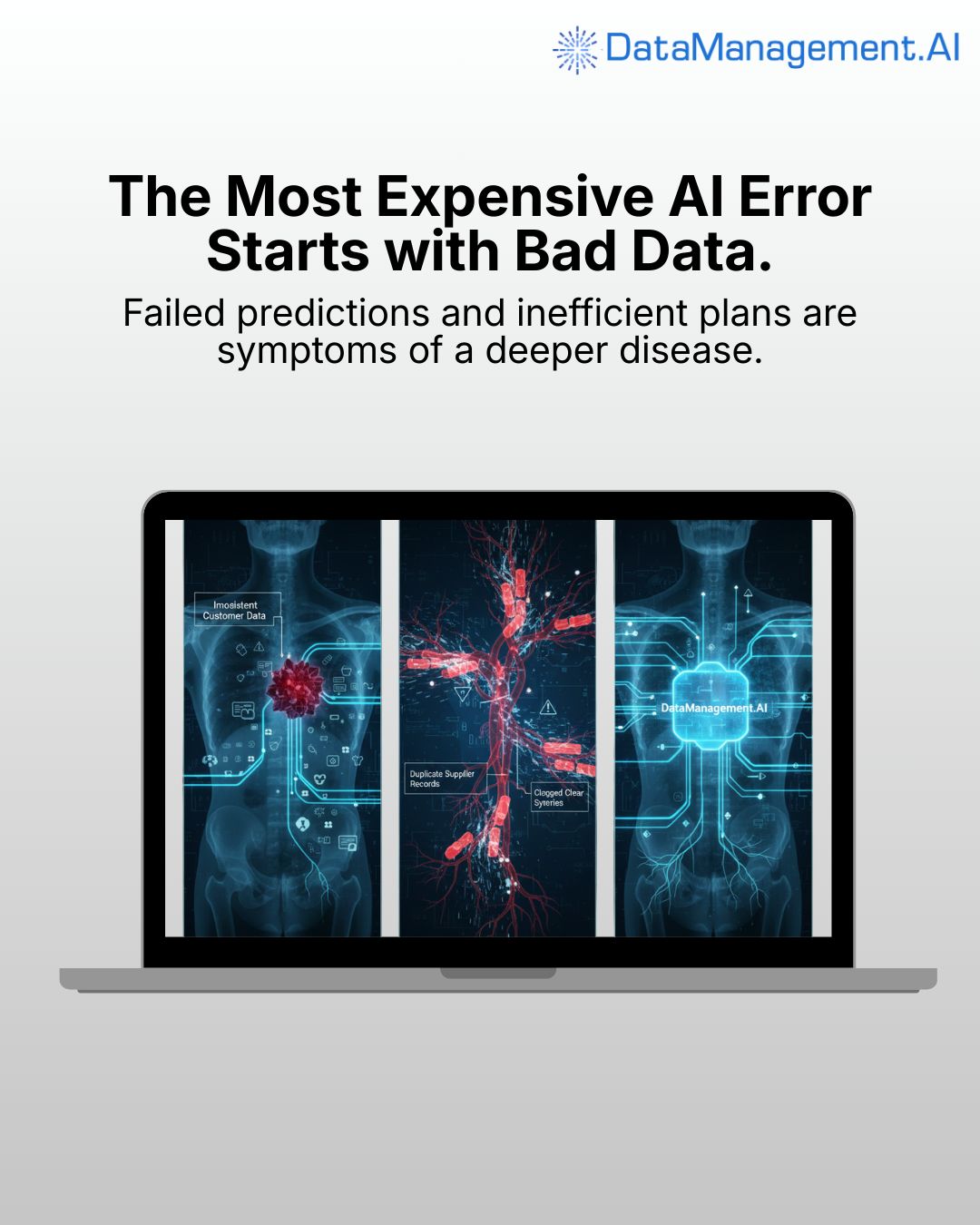
Your journey toward an intelligent enterprise will stall at the starting gate if the master data fuel is contaminated.
From Managing Data Objects to Governing Business Outcomes
Traditional master data management (MDM) programs have often failed to deliver expected value because they start from the wrong premise. They typically focus inward, on the data object itself, striving for a "single source of truth" for the "customer" or "product" entity in a vacuum.

Governance models become rigid, focused on data stewardship councils and change request workflows that are disconnected from the dynamic, real-world flow of business operations.
You may achieve a technically "clean" dataset in a central hub, but if that data is not aligned with how your Purchase-to-Pay process actually works in SAP, Oracle, and your legacy systems, the problems persist. The data is managed, but the business does not improve.
The revolutionary approach of the Master Data Performance Center (MDPC), developed by Capgemini Invent with Celonis, is to invert this model entirely. Instead of starting with the data, you start with the business process.

The MDPC is built upon the Celonis Process Intelligence Platform, a technology that acts like an MRI scan for your business operations. It ingests event logs from your core systems (ERP, CRM, SCM) and reconstructs the actual, as-is flow of every transaction.
The MDPC layer then connects your master data directly to this living map of your core processes, Procure-to-Pay, Order-to-Cash, Record-to-Report, and more. This fusion creates a cause-and-effect map of unprecedented clarity.
For the first time, you can move from vague suspicion to precise diagnosis:
You don't just know "supplier data is bad." You can see that inconsistent "payment term" fields for Vendor X in System A vs. System B are causing a 14-day delay in 30% of invoices, leading to €250,000 in annual missed cash discounts.
You don't just sense "inventory is bloated." You can analyze that duplicate material codes for "Stainless Steel Bolt M10" (coded as MAT-1001 and MAT-1077) have led to fragmented procurement, 15% excess safety stock, and €1.2 million in tied-up working capital.
You can identify which specific data attributes are "control points" for automation. For instance, you learn that for your automated goods receipt process to succeed with 99% accuracy, the fields "Material Number," "Batch Number," and "Vendor ID" must be 100% complete and consistent. This allows you to focus improvement efforts with surgical precision.
Master data is thus transformed. It ceases to be a static asset on an IT balance sheet and becomes a dynamic, real-time performance lever. You gain the ability to directly measure how pulling this lever, fixing a specific data attribute, impacts a key business KPI like cost, cycle time, or cash flow.
The Core Technology: Object-Centric Process Mining as Your Diagnostic Engine
The magic that enables this shift is a next-generation technology called object-centric process mining. Traditional process mining often takes a single, linear view (e.g., following the "purchase order" from creation to payment).
However, in real business, multiple objects, a Purchase Order, a Material, a Vendor, a Goods Receipt, interact in a complex web. Object-centric process mining captures this multidimensional reality.

Think of it this way: Instead of just tracking the "journey of a PO," it simultaneously tracks the "journey of a material" across all POs, inventories, and production orders, and the "journey of a vendor" across all interactions.
The MDPC uses this capability to provide an end-to-end view of how master data objects behave and interact across system and departmental silos. This is what allows you to perform root-cause analysis that was previously impossible.
You can detect that a data issue originating in the onboarding workflow in Salesforce manifests as a delivery failure in SAP Logistics and a billing dispute in your finance system. You can trace the financial impact across this entire chain.
The platform then operationalizes these insights through execution management capabilities. It doesn't just show you a dashboard and wish you good luck. It enables you to build automated action flows:
Detection: The system identifies a vendor invoice stuck in exception due to a mismatched tax ID.
Orchestration: It automatically routes a remediation task to the correct data steward's queue in your workflow tool (e.g., ServiceNow).
Action: The steward corrects the tax ID in the central MDM hub.
Verification: The system monitors the related process instances to confirm that the blockage is cleared and that the invoice is paid, calculating the recovered cash discount.
Learning: The pattern is logged, helping to potentially automate the fix in the future or flag similar vendor records for proactive cleansing.
This creates a closed-loop, continuous improvement cycle where insight directly fuels action, and action generates measurable results.
A technological solution alone will fail if the organization does not change how it works. Historically, master data was "owned" by IT or a small, overwhelmed central data governance team.

The MDPC is designed to foster a culture of shared accountability by providing role-specific value to every stakeholder in the data chain.
For the Executive (CEO, CFO, COO): The Management View provides a cockpit dashboard. It translates data health into business health, showing metrics like "Cost of Poor Data," "Revenue at Risk," and "Process Efficiency Gains." It answers the question: "What is the ROI of our data investment?" This enables data governance to be discussed as a strategic business initiative, not an IT cost.
For the Business Leader (Head of Procurement, VP of Supply Chain): The Tactical View offers deep-dive analytics. A procurement director can see which vendor data issues are causing the most purchase order exceptions, ranked by financial impact. They can prioritize cleansing efforts for the supplier categories that will most improve operational efficiency and leverage for their team.
For the Data Steward and Operational Team: The Operational View is a workbench. It provides specific, actionable tickets: "Vendor ACME Corp has an incomplete bank detail in System A. Click here to remediate." It empowers them to resolve issues at the source and see the direct impact of their work, transforming a thankless task into a value-creating activity.
This triad ensures that everyone, from the C-suite to the frontline, understands their role in the data value chain and is equipped with the right tools to execute it.
From Proof to Scale: Your Roadmap to Data-Driven Performance
The journey from recognizing the problem to achieving scalable performance requires a deliberate, phased approach.
Phase 1: Discover and Quantify (Weeks 1-8). Begin by connecting the MDPC to one or two critical processes, such as Procure-to-Pay. Do not attempt a "big bang" enterprise rollout. The goal here is not to fix everything, but to shine a light and build your business case with irrefutable, process-mined evidence.
Answer the question: "What is the specific financial and operational cost of poor master data in our most impactful process?"
Phase 2: Prioritize and Pilot (Months 3-6). Using the quantified insights, select the top three to five master data issues with the highest business impact. Form a dedicated, cross-functional squad with a business process owner, a data steward, and an IT specialist.
Use the MDPC's action flows to run a focused remediation pilot. Measure the before-and-after impact on process KPIs (e.g., First-Time-Right rate, cycle time, cost). This creates your first set of success stories and a reusable playbook.
Phase 3: Expand and Operationalize (Months 6-18). Scale the model to adjacent processes (Order-to-Cash, Record-to-Report). Institutionalize the role-based operating model. Integrate data quality KPIs from the MDPC into the performance scorecards of business leaders. Begin using the cleansed, trusted data to fuel the next wave of automation and AI projects with a much higher likelihood of success.
Phase 4: Innovate and Predict (Ongoing). With a mature performance-driven data foundation, you can move into predictive governance. Use historical process and data quality trends to predict where failures are likely to occur next and intervene proactively. Feed high-quality, contextual master data into AI models for advanced forecasting, dynamic pricing, and predictive maintenance, unlocking the full promise of your intelligent enterprise.
Securing Your Competitive Advantage in the Intelligent Age
Your organization stands at a crossroads. You can continue to treat master data as a hidden, technical liability, a cost center that you grudgingly fund while wondering why your digital transformation yields disappointing returns.

Or, you can embrace it as the most powerful performance engine available to you.
The Master Data Performance Center provides the blueprint and the technology to make this shift. It moves you from a world of guesswork and reaction to a world of measurement, precision, and proactive control.

In the coming age of AI, competitive advantage will not be determined solely by who has the best algorithms, but by who has the best data foundations. The organizations that win will be those that can seamlessly connect data quality to process execution to business outcomes.
By adopting this process-first, performance-centric approach to master data, you are not just fixing a system; you are building a fundamental, durable, and scalable source of efficiency, resilience, and competitive power.
The time to start is now. Your data is ready to work for you; you simply need to give it the platform to perform.
Warm regards,
Shen and Team