The $6 Billion Leak: Plugging Waste in Market Data Spending with AI
Solving the Market Data Crisis

Shen Pandi
September 24, 2025
As a leader in the financial services sector, you are navigating a perfect storm in market data management. The very data that fuels your trading, risk management, and regulatory compliance is becoming a significant and unpredictable cost center.
The industry's annual market data spend has already surpassed $42 billion, and projections indicate it will soar to $67 billion by 2030.
You face this acceleration driven by rising consumption, stricter compliance mandates, and the insatiable data demands of AI and alternative data sources.
The core of the problem lies in an outdated operational model. Traditional approaches are characterized by manual processes, fragmented procurement, and opaque vendor relationships.
We estimate that your firm, like many others, is likely overspending by up to 30% due to inefficient contract structures, a lack of negotiation leverage, and no access to critical benchmarking data.
Furthermore, inefficiencies in demand management, such as redundant subscriptions and poor usage forecasting, account for an estimated $6 billion in wasted costs across the industry annually.
Embracing an AI-Driven Strategy for Competitive Advantage
This whitepaper outlines a path forward. It explores the critical challenges you face and demonstrates how a strategic shift, powered by AI and predictive analytics, can transform your market data function.
By moving from a reactive, cost-heavy operation to a proactive, intelligent, and value-generating discipline, you can not only contain costs but also unlock new competitive advantages.
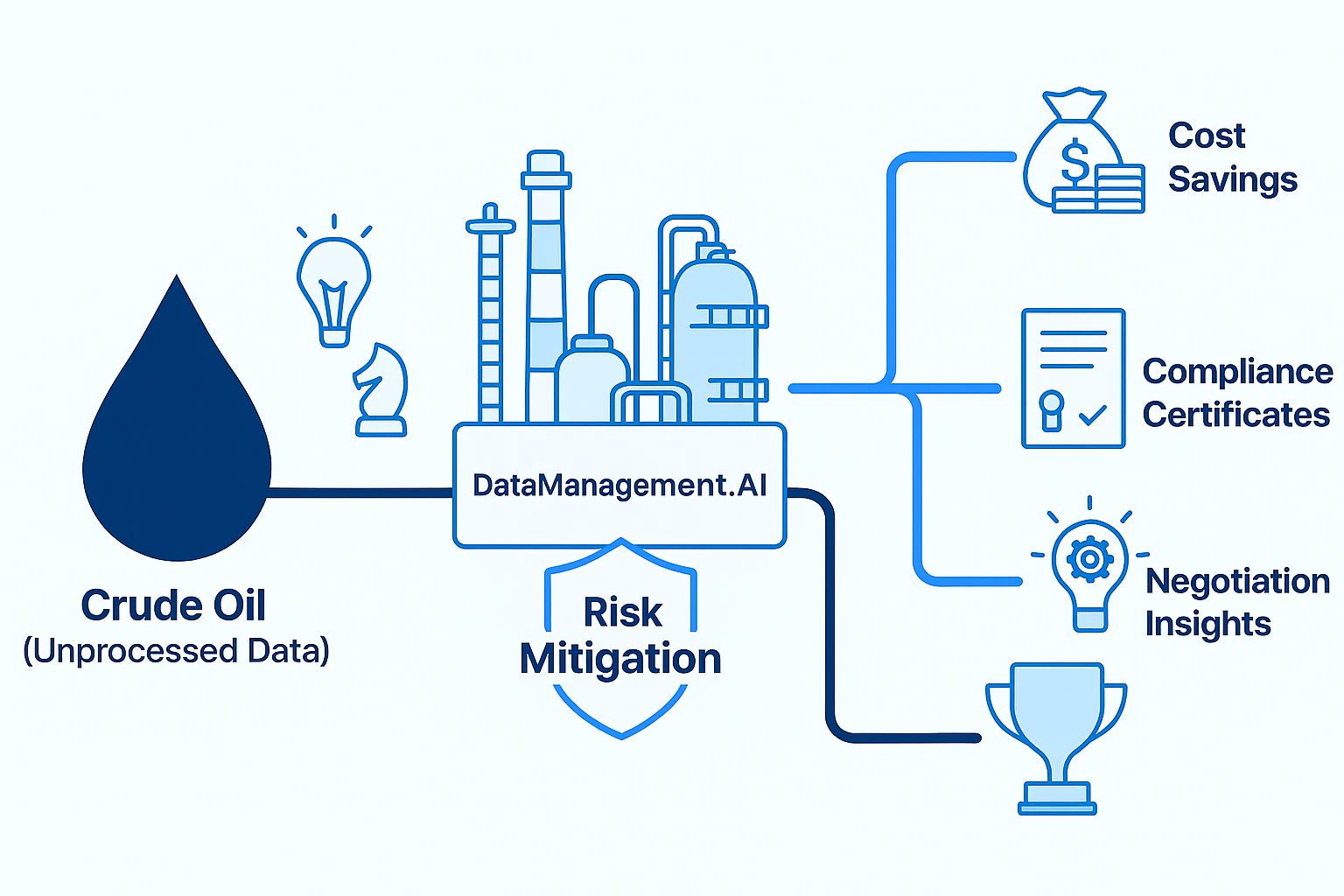
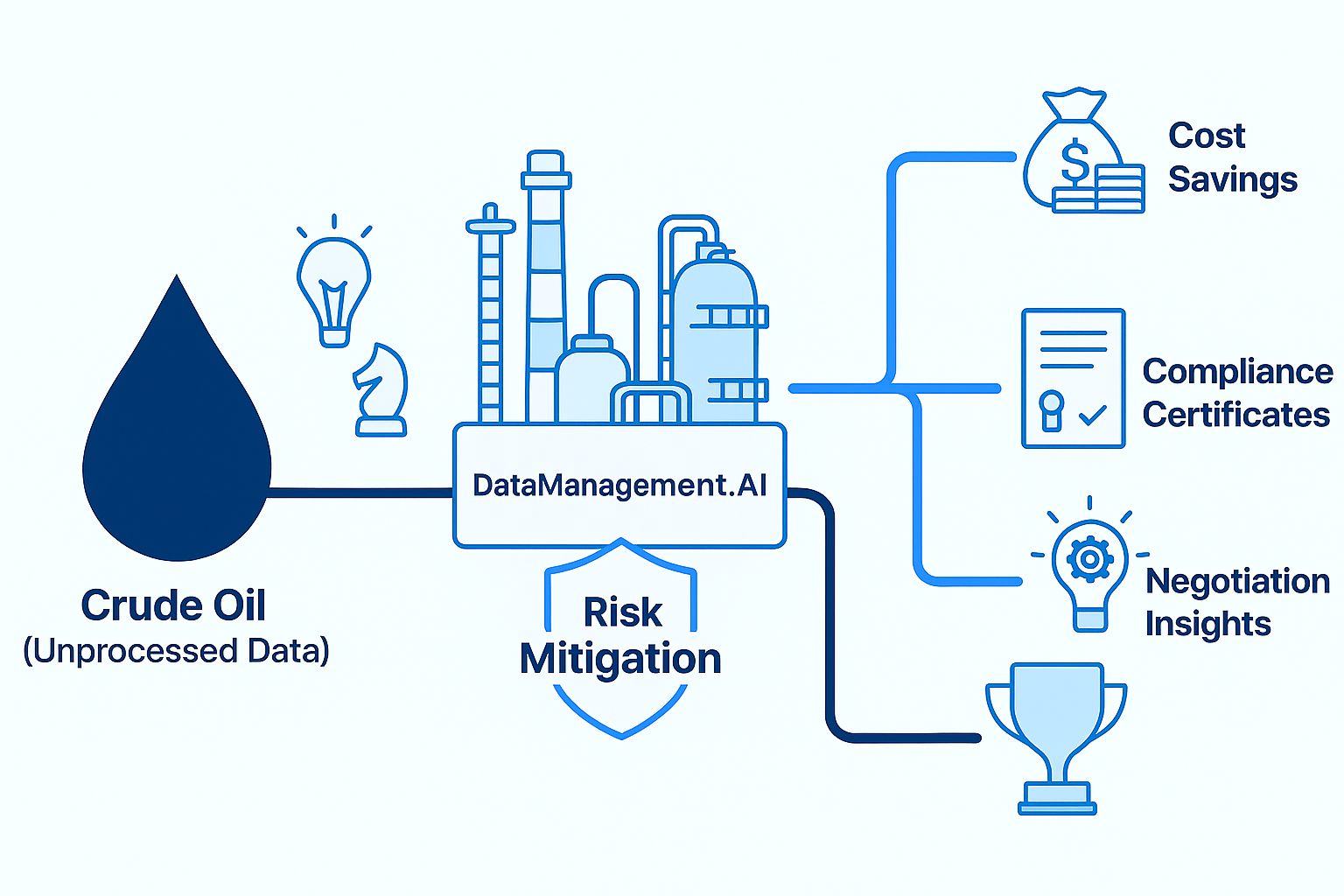
Leveraging a dedicated platform like DataManagement.AI is central to this transformation, enabling you to achieve unprecedented levels of cost transparency, operational efficiency, and governance control.
Part 1: The Critical Market Data Challenges You Face
Your struggle with market data management likely manifests in four key areas, each contributing to financial leakage and operational risk.
1. The Transparency Deficit: Limited Visibility into Usage and Spend

Without a unified, intelligent system, gaining a clear view of your market data ecosystem is nearly impossible.
Your contracts are likely scattered across emails, shared drives, and individual silos, making it difficult to track renewal dates, analyze terms and conditions, and understand actual data consumption.
This lack of centralized visibility means you miss optimization opportunities, fail to decommission unused services, and struggle to allocate costs accurately.
The consequence is a steady, unnoticed bleed of your budget, estimated at 10% of annual spend, simply due to poor contract management and a reactive posture.
2. The Negotiation Disadvantage: Ineffective Contract Alignment

You are likely locked into vendor-dominated relationships characterized by rigid, opaque pricing models. The fundamental asymmetry of information between you and your data providers puts you at a significant disadvantage during negotiations.
Without data-driven insights into how your contract terms and pricing compare to industry peers, you lack the leverage to secure fair and flexible agreements.
This results in overspending compared to market benchmarks and contracts that do not align with your actual business needs, locking you into long-term commitments that fail to adapt to changing conditions.
3. The Demand Management Gap: Operational Inefficiencies
A significant portion of your waste stems from an inability to manage demand effectively. Vendor fragmentation leads to duplicative contracts, while a lack of insight into usage patterns means you pay for subscriptions that provide minimal value.
The traditional, manual process of forecasting data needs is inherently flawed, leading to both over-provisioning and under-licensing.
This operational gap, which wastes approximately 15% of total industry spend, directly impacts your bottom line without contributing to your strategic objectives.
4. The Compliance Threat: Governance and Audit Risks

Market data contracts impose strict, complex restrictions on data usage, redistribution, and user access. The financial and reputational risks of non-compliance are severe, with penalties for contractual breaches ranging from 10% to 30% of your total data spend.
As vendors become more aggressive in their audit practices, you are exposed to potential fines running into millions of dollars annually.
Manual compliance checks and outdated entitlement systems are no longer sufficient to protect your organization. You need enforceable, automated policies and detailed audit trails to prove compliance and mitigate this growing risk.
Part 2: The Pillars of a Modern, AI-Driven Market Data Strategy
To overcome these challenges, your strategy must be rebuilt on three interconnected pillars. This is where a sophisticated platform proves its worth, moving beyond simple spreadsheet tracking to an integrated, intelligent system.
Pillar 1: A Centralized and Intelligent Contract Repository

The foundation of your new approach must be a single source of truth for all market data agreements. This goes beyond a simple digital filing cabinet.
A true centralized repository, like the core of the DataManagement.AI platform, intelligently parses contracts to extract key terms, pricing models, renewal dates, and usage restrictions.
This gives you instant visibility into your entire portfolio, enabling proactive renewal management, identification of cost-saving opportunities, and seamless audit responses. It transforms your contract data from a static liability into a dynamic asset for strategic planning.
To fully address your market data challenges, you need more than a contract repository; you need a Context Cloud, unlike systems that merely store documents, a Context Cloud creates intelligent relationships across all your data sources.
It automatically ingests and analyzes unstructured information from contracts, invoices, compliance documents, and usage reports, transforming them into an interconnected knowledge graph. This provides deep contextual understanding, linking contractual terms to actual consumption patterns, vendor performance, and compliance requirements.
By moving beyond siloed information to connected intelligence, the Context Cloud delivers the holistic visibility needed to optimize costs, mitigate risks, and transform market data into a strategic asset.
Pillar 2: Automated Governance and Proactive Risk Control
Strong governance is non-negotiable. You need to implement a clear policy framework supported by technology that enforces rules in real-time. This involves assigning data stewardship responsibilities and establishing automated workflows for access requests and approvals.
The DataManagement.AI platform excels here by using AI to continuously monitor data access and usage patterns against contractual obligations.
It can flag potential policy violations before they escalate into audit failures, providing you with a powerful shield against compliance risks and creating a culture of responsible data stewardship across your organization.
Pillar 3: Data-Driven Vendor and Deal Management
The final pillar empowers you to shift from a passive buyer to a strategic partner in vendor relationships. By leveraging the analytics and benchmarking capabilities within your management platform, you can base negotiations on hard evidence.
You can answer critical questions: Are we paying a fair price compared to our peers? Is this vendor’s performance meeting their SLAs?
How can we optimize our license tiers based on actual usage? This data-driven approach, powered by the intelligence gathered by DataManagement.AI, can improve your negotiation outcomes by up to 20%, ensuring that every dollar spent on market data delivers maximum value.
Part 3: Your Smarter Solution: The Synergy of AI and Human Expertise
The future of market data management is not about replacing your team with algorithms; it is about augmenting their expertise with powerful technology.
The goal is to create a symbiotic relationship where AI handles the high-volume, repetitive tasks, such as invoice validation, contract analysis, and compliance monitoring, freeing your domain experts to focus on strategic analysis, vendor relationship management, and data innovation.
This integrated model, which DataManagement.AI is specifically designed to enable, combines three critical elements:
AI and Automation: To eliminate manual effort and reduce human error.
Predictive Analytics and Business Intelligence: To provide actionable insights for forecasting and optimization.
Human Expertise: To interpret insights, apply business context, and make strategic decisions.
By uniting these elements, you create a proactive, intelligent function. Your team is no longer bogged down by administrative firefighting but is empowered to drive value, manage risk, and support the evolving data needs of your business units.
At the heart of these three pillars lies a critical capability that distinguishes a true data management platform from a simple contract repository: the intelligent analysis of unstructured data.
Your market data ecosystem is documented across a labyrinth of complex contracts, vendor invoices, usage reports, compliance manuals, and internal emails.
Traditionally, the valuable information within these documents remains locked away, inaccessible for strategic analysis.
DataManagement.AI transcends this limitation by leveraging advanced AI and Natural Language Processing (NLP) to automatically parse, categorize, and analyze this unstructured information. It doesn't just store contracts; it understands them.
It extracts key clauses, pricing terms, usage rights, and restrictions, transforming scattered documents into a structured, queryable knowledge graph.
This deep analysis provides the foundational intelligence that powers proactive cost optimization, accurate benchmarking, and robust risk management, ensuring your strategy is informed by a complete view of your data landscape, not just a partial one.
Turning Your Data Burden into a Strategic Edge
The rising tide of market data costs and risks is a formidable challenge, but it is also a significant opportunity. Firms that cling to manual, reactive methods will see their margins erode and their risks multiply. In contrast, you have the opportunity to lead your organization through a fundamental transformation.

By embracing an AI-driven platform like DataManagement.AI, you can transform your market data operations from a perennial cost burden into a demonstrable source of competitive advantage.
You will achieve not just substantial cost savings and ironclad compliance, but also the agility and insight needed to thrive in an increasingly complex data economy.
The journey to smarter market data management starts with a single step: gaining control. From there, you can begin to unlock the full strategic potential of your most critical asset, your data.
Warm regards,
Shen and Team